The following CNN Money video report highlights one woman in Connecticut who is in a homeless shelter with her children, even though she continues to work. The mother discusses her employment, her desire to improve her opportunities by studying nursing, and her children.
money.cnn.com/video/news/2010/08/03/n_working_homeless_shelter.cnnmoney/index.html
Monday, October 11, 2010


Sunday, October 10, 2010
Fresh Start Program Attempts to Break the Cycle of Incarceration & Substance Abuse
 "A Berrien County program aimed at curbing recidivism for female jail inmates is catching the national eye.
The Fresh Start Prevention Program, started in 2009 by Abundant Life Ministries in Benton Harbor and partly funded by the county, has shown successful gains in its first year and a half, officials said.
Marletta Seats, Berrien County commissioner for District 3 and the catalyst for Fresh Start, said about 263 women and 53 men have participated in the program, with 40 people graduating from the eight- to 10-week course.
The program's key goal is to help the inmates overcome drug addictions through counseling."
www.southbendtribune.com/article/20101010/News01/10100395/1052/News01
Saturday, October 9, 2010
Berrien County Task Force Looks to Reduce Health Care Gap
"Being healthy has a lot to do with a paycheck.
"Good jobs are the best thing you can do for public health," said Duane McBride, chairman of the Berrien County Board of Health, during a discussion this week with health department employees on the connections between employment and personal well-being.
Theresa Green, director of community health planning for the department, on Wednesday screened a portion of a documentary, "Unnatural Causes" (subtitled "Not Just a Paycheck"), which chronicled the impact of industrial layoffs on the west Michigan town of Greenville. In 2006, refrigerator manufacturer Electrolux, based in Sweden, moved 3,000 jobs from Greenville to Mexico.
In the year after the plant closed, the number of reported cases of depression, attempted suicide and domestic violence in Greenville reportedly tripled.
Board of health members noted the similar loss of high-paying manufacturing jobs in Berrien County.
Ultimately, wealth is the most reliable predictor of health, said Green, who in August formed the Health Equity Task Force through a $15,000 grant from the Michigan Department of Community Health. The task force seeks to reduce health disparities between the poor and other residents of Berrien County.
Children who live in poverty are seven times more likely to be in poor health than those in higher-income households..."
www.heraldpalladium.com/articles/2010/10/09/local_news/2101983.txt
"Good jobs are the best thing you can do for public health," said Duane McBride, chairman of the Berrien County Board of Health, during a discussion this week with health department employees on the connections between employment and personal well-being.
Theresa Green, director of community health planning for the department, on Wednesday screened a portion of a documentary, "Unnatural Causes" (subtitled "Not Just a Paycheck"), which chronicled the impact of industrial layoffs on the west Michigan town of Greenville. In 2006, refrigerator manufacturer Electrolux, based in Sweden, moved 3,000 jobs from Greenville to Mexico.
In the year after the plant closed, the number of reported cases of depression, attempted suicide and domestic violence in Greenville reportedly tripled.
Board of health members noted the similar loss of high-paying manufacturing jobs in Berrien County.
Ultimately, wealth is the most reliable predictor of health, said Green, who in August formed the Health Equity Task Force through a $15,000 grant from the Michigan Department of Community Health. The task force seeks to reduce health disparities between the poor and other residents of Berrien County.
Children who live in poverty are seven times more likely to be in poor health than those in higher-income households..."
www.heraldpalladium.com/articles/2010/10/09/local_news/2101983.txt
Thursday, October 7, 2010
Is increasing minimum wage the answer? A decade ago in Kalamazoo, we said "no"
 A new poll released yesterday by the Public Religion Research Institute, shows that two-thirds of Americans (67 percent) support an increase in the minimum wage from $7.25 an hour to at least $10 an hour.
One could say that the easiest way to reduce poverty is by offering more jobs that pay higher salaries so that everyone has the opportunity to succeed. But would those who live now in poverty really have a chance at these opportunities? Would they be competing with more educated, training and skilled workers? Would a minimum wage hike hurt small businesses?
These are all challenging questions that must be addressed when speaking about this topic. In Kalamazoo in 2001, the community decided that a living wage was not the best way to address the high percentage of poverty in the area. A few years later, the Kalamazoo County Poverty Reduction Initiative was formed to address the problem. Soon afterward, Kalamazoo leaders unveiled the Kalamazoo Promise as a way to support children and families living in poverty.
Raising the minimum wage would certainly have a positive impact on persons who currently make the amount. However, it could potential devastate an economy still struggling to improve. Small businesses could flounder and more jobs could be cut.
Is increasing the living wage the long-term answer? What supports for businesses would we have to include to make it affordable?
Read the Full Article: http://www.mlive.com/michigan-job-search/index.ssf/2010/10/poll_two-thirds_of_americans_support_min.html
Tuesday, October 5, 2010
NPR Reports on the 'Disintegration' Of America's Black Neighborhoods
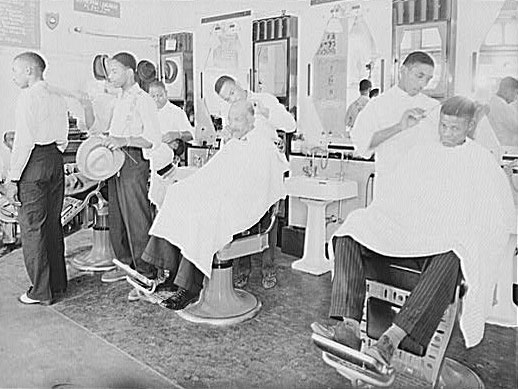
A new book written by Eugene Robinson details the splintering of African-American communities and neighborhoods. His new book is called Disintegration: The Splintering of Black America. Robinson grew up in a segregated world in Orangeburg, S.C., which had a black side of town and a white side of town. It also had a black high school and a white high school; and "two separate and unequal school systems."
But as segregation faded, pockets of inequality grew even stronger. The story explains:
"People who had the means and had the education started moving out of what had been the historic black neighborhoods," Robinson explains.
He cites Washington, D.C.'s Shaw neighborhood as a prime example of this because of how Shaw was home to a vibrant black community and a thriving entertainment scene in the 1930s through the 1950s. By the '70s, Shaw had become a desolate, drug-ridden area.
"In city after city, African-American neighborhoods, that …once had been vibrant and in a sense whole — disintegrated," Robinson says.
He attributes that change to African-Americans taking advantage of new opportunities, resulting in a more economically segregated community.
"There have always been class distinctions in the black community," Robinson says, "but what I believe we've seen is an increasing distance between two large groups, which I identify as the Mainstream and the Abandoned."
Robinson says that while a "fairly slim majority" of African-Americans entered the middle class, a large portion of the community never climbed the ladder. It's getting harder and harder to catch up, he says, "because so many rungs of that ladder are now missing."
So as formerly segregated neighborhoods begin to gentrify; rents increase and longtime residents get pushed out.
"What happens to this group that I call the Abandoned is that they get shoved around — increasingly out into the inner suburbs — and end up almost out of sight, out of mind," Robinson says.
Read or listen to the full story: http://www.npr.org/templates/story/story.php?storyId=130333806&sc=fb&cc=fp
Sunday, October 3, 2010
The Political Candidates Don't Come Here (Where the Poor Are) Often

"The political candidates don’t come here very often. Not to Veronica Almaguer’s office.
Not to the place where all those issues — such as unemployment and health care and education and hunger — collide into a single look of desperation from the other side of her desk.
If the candidates came here, she says, maybe it wouldn’t take so long to find a solution to the state’s high unemployment
“We’re seeing a significant increase in the number of people who need help,” she says. “We have people who are unemployed for the time. They lost their jobs and their medical insurance. And many people have never had to ask for help before.”
Almaguer is the prescription assistance coordinator at Cristo Rey Community Center, a charity on Lansing’s High Street that offers a range of services, including a free medical clinic and food bank."
www.lansingstatejournal.com/article/20101003/NEWS01/310030004/1001/NEWSSaturday, October 2, 2010

Walmart Sales Spike Last Day of the Month When Benefits Checks Come In
 Take a trip to one of those 24-hour Walmarts on the last day of every month, and you'll get a glimpse into the lives of low-income families trying to get by. At one location in Fredericksburg, Va., at around 11 p.m., families start to load up on necessities like diapers and groceries.
 People like Tracy and Martin Young live nearby, and for the pair in their early 30s, it's a chance to shop quietly without their five children, two of whom are teenagers. Each is pushing a shopping cart overflowing with food. There's mac and cheese, bags of cereal and cans of evaporated milk. Most of this has to last for the whole month.
www.npr.org/templates/story/story.php?storyId=130272928Homeless Men Sent to Prison While Ring Leader Evades the Law
Staying at a Grand Rapids homeless shelter, Guy Robert Clawson was offered a cash "job" that covered his beer or liquor for the day.
For years, he worked odd jobs for cash. This seemed no different.
The offer came from a guy named Malik. Clawson and other homeless people could earn $15 to $20 a day buying cold tablets that contained pseudoephedrine, a restricted product that was used to make methamphetamine, authorities said.
Malik drove to stores throughout West Michigan, and supplied cash for the pills. The buyers got $2.50 a box.
www.mlive.com/news/grand-rapids/index.ssf/2010/10/homeless_men_sent_to_prison_wh.html
Thursday, September 30, 2010
The Gubernatorial Candidates on Early Childhood Education
 The Center for Michigan does a nice job of highlighting the educational support that both candidates for Governor, Mr. Snyder and Mr. Bernero, have for early childhood education:
"In August, both Republican gubernatorial candidate Rick Snyder and his Democratic opponent, Virg Bernero spoke in support of preschool at the Sandbox Party Convention, an event to help spread the word about the economic impact of early childhood education in the state.
“Reform Michigan’s Educational System” is Number 8 on Snyder’s 10-point plan to reinvent Michigan.
And Bernero has often said that education is economic development.
Bernero campaign spokesman Cullen Schwarz said it is now a widely accepted fact that preschool education is vital for the cognitive development of children and is a major factor in future academic success.
“Virg’s goal is to have every four-year-old in Michigan enrolled in pre-school by the end of his first term,” he said. “Michigan needs a strong pre-K program that has uniform benchmarks and quality standards to ensure that all our children are getting a jump-start on gaining the tools to succeed in a global economy.”
Snyder campaign spokesman Bill Nowling said Snyder does not yet have a specific preschool proposal, but believes the state must refocus its effort on 0-5 learning because of its proven return on investment. That will require using what Snyder calls “value for money budgeting.”
The full report can be found at:www.thecenterformichigan.net/special-report-where-bernero-and-snyder-stand-on-early-education/
Subscribe to:
Posts (Atom)

 Posts
Posts


