- As reported by the Detroit Bureau, The Michigan Unemployment rate is the highest in the last 26 years and will probably get worse even if the economy improves. The 14.1 percent is highest since it hit 14.2 in 1983 losing 24,000 payroll jobs in May and shedding 303,000 jobs in the past 12 months.
- The Kalamazoo Community Mental Health has bought a new building, but has put the move on hold because it wants to wait until plans for a downtown arena are finalized and the state's budget picture becomes more clear.
Showing posts with label economy. Show all posts
Showing posts with label economy. Show all posts
Thursday, June 18, 2009
Michigan Unemployment rate highest in 26 years


Wednesday, June 3, 2009
GM Forced to Restructure Through Bankruptcy
As I vacationed for 4 days over the weekend, I came back to find that Michigan news was really focused on two stories: The bankruptcy of GM and the Detroit Red Wings. Well, only one of these stories really applies to the equity of Southwest Michigan and PRI (well, unless you consider hockey a systemic barrier break sport).
Despite all the gloom and doom scenarios, Chicago Fed Senior Economist William Straus actually things the deal that GM brokered will be good for Michigan, or at least put us on a better path. His comments below:
Despite all the gloom and doom scenarios, Chicago Fed Senior Economist William Straus actually things the deal that GM brokered will be good for Michigan, or at least put us on a better path. His comments below:
Monday, May 11, 2009
Monday Round-up
News Highlights:
State budget cuts hit home in Southwest Michigan
As the dust begins to settle on $349 million in state budget cuts ordered last week, the local impact is beginning to sink in -- from state trooper posts to county fairs to local health departments. The Kalamazoo Gazette breaks down what the budget cuts will have in store for Southwest Michigan, including the topics of: state police, human services, healthy care, agriculture & county fairs, the arts, and revenue sharing.
Carrier to Discontinue Tyler Brand Line and Close Plant in Niles, Michigan
The previous article speaks about how Berrian County has been able to weather the storm better than other areas in SW Michigan. That was before it was announced that 500 jobs were to be cut in by the closing of a plant in Niles. These are huge job losses for a city with a population of only 11 thousand residents.
More on the story: News of Tyler Refrigeration closing is 'devastating'
Which is our kind of town?
Article debates on whether Southwest Michigan is more like Chicago or Detroit.
Volunteers begin building playground for kids at Kalamazoo's Peace House
PRI Americorps Maggie Haitt and Ernest Cawvey helped make the improvements at the Peace House that the article speaks about.
State budget cuts hit home in Southwest Michigan
As the dust begins to settle on $349 million in state budget cuts ordered last week, the local impact is beginning to sink in -- from state trooper posts to county fairs to local health departments. The Kalamazoo Gazette breaks down what the budget cuts will have in store for Southwest Michigan, including the topics of: state police, human services, healthy care, agriculture & county fairs, the arts, and revenue sharing.
Carrier to Discontinue Tyler Brand Line and Close Plant in Niles, Michigan
The previous article speaks about how Berrian County has been able to weather the storm better than other areas in SW Michigan. That was before it was announced that 500 jobs were to be cut in by the closing of a plant in Niles. These are huge job losses for a city with a population of only 11 thousand residents.
More on the story: News of Tyler Refrigeration closing is 'devastating'
Which is our kind of town?
Article debates on whether Southwest Michigan is more like Chicago or Detroit.
Volunteers begin building playground for kids at Kalamazoo's Peace House
PRI Americorps Maggie Haitt and Ernest Cawvey helped make the improvements at the Peace House that the article speaks about.
Monday, May 4, 2009
May 5th: Vote nears for Public Transit, Public library
On Tuesday, May 5th voters will decide upon whether to renew two mileages - one for the public transit system in Kalamazoo and the other to support the public libraries. These mileages both have extreme importance to the vitality of residents in Kalamazoo County.
The Poverty Reduction Initiative supports both Mileages as both services play large roles in reducing negative effects of poverty such as: increased mobility, access to goods and services, access to educational resources, access to digital media, and much more.
Many people inside both the city of Kalamazoo and the county use the public transit system to reach their employers, visit educational programs, receive goods and services, and stay connected within their community. Getting rid of this service not only hurts these residents, but also degrades the overall economic well-being of the region.
Many are familiar with the educational and economic advantages of having a public library with effective services. This resources increases resident literacy, technological skills and even employment skills.
Please take a moment on May 5th to vote yes for both proposals. The cost of these services is negligible juxtaposed to the benefits they provide to our community.

The Poverty Reduction Initiative supports both Mileages as both services play large roles in reducing negative effects of poverty such as: increased mobility, access to goods and services, access to educational resources, access to digital media, and much more.
Many people inside both the city of Kalamazoo and the county use the public transit system to reach their employers, visit educational programs, receive goods and services, and stay connected within their community. Getting rid of this service not only hurts these residents, but also degrades the overall economic well-being of the region.
Many are familiar with the educational and economic advantages of having a public library with effective services. This resources increases resident literacy, technological skills and even employment skills.
Please take a moment on May 5th to vote yes for both proposals. The cost of these services is negligible juxtaposed to the benefits they provide to our community.

Monday, April 20, 2009
Apparently, Debtors Prisons Have Returned

A couple weeks ago, the New York Times reported on a recent phenomenon happening around the United States: Imprisonment for debt. Here's a segment from the story:
The article later concludes:"Here is a tale that sounds like it comes right from the pages of “Little Dorrit,” Charles Dickens’s scathing indictment of VictorianEngland’s debtors’ prisons. Unfortunately, it is happening in 21st-century America.
Edwina Nowlin, a poor Michigan resident, was ordered to reimburse a juvenile detention center $104 a month for holding her 16-year-old son. When she explained to the court that she could not afford to pay, Ms. Nowlin was sent to prison. The American Civil Liberties Union of Michigan, which helped get her out last week after she spent 28 days behind bars, says it is seeing more people being sent to jail because they cannot make various court-ordered payments. That is both barbaric and unconstitutional.
In 1970, the Supreme Court ruled that it violates equal protection to keep inmates in prison extra time because they are too poor to pay a fine or court costs. More recently, the court ruled that a state generally cannot revoke a defendant’s probation and imprison him for failing to pay a fine if he is unable to do so."
"Prisoners’ rights advocates worry that in these hard times, when government budgets are under pressure, courts and prisons will get even tougher about forcing indigent defendants to pay costs and fees, and will imprison more of them if they cannot come up with the money. The government should be helping people on society’s margins build productive lives. Throwing them in jail for being poor makes that much more difficult."This is a scary and sobering story, of which its main example inexcusably comes from our state! I always assumed this was one of our most basic rights; I guess some governmental bodies are in disagreement, brought on by very desperate times. I hope we can get past these archaic methods - jailing someone impoverished is a quick way to inflame the problem, not a solution to state budget woes.
It certainly serves as an example, albeit an extreme one, to the complexity of economic struggles in both our state and America as a whole. We need to pull together our resources now and unite, not fight the poorest population for every last dollar.
Friday, April 17, 2009
Obama Administration's Vision for a High Speed Rail
This week the Obama Administration revealed its plans for a system of high speed rail in major America regions. Courtesy of West Michigan Rising, the administration has mapped out several areas across the country it hopes to improve:

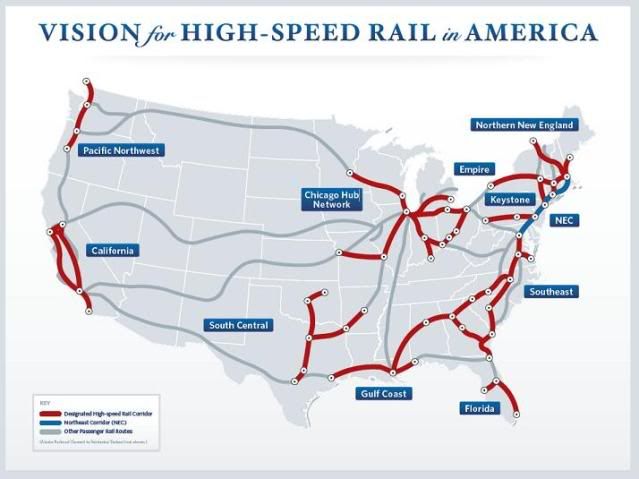
"President Obama's vision for high-speed rail mirrors that of President Eisenhower, the father of the Interstate highway system, which revolutionized the way Americans traveled. Now, high-speed rail has the potential to reduce U.S. dependence on foreign oil, lower harmful carbon emissions, foster new economic development and give travelers more choices when it comes to moving around the country."The administration is focusing intently on the Midwest region, where it hopes to connect major cities in the area with the economic hub of Chicago. Which cities would it include as stops on this train? Only time will tell, but I'm sure some of it will be up to us as citizens to promote our cities as ideal stops.
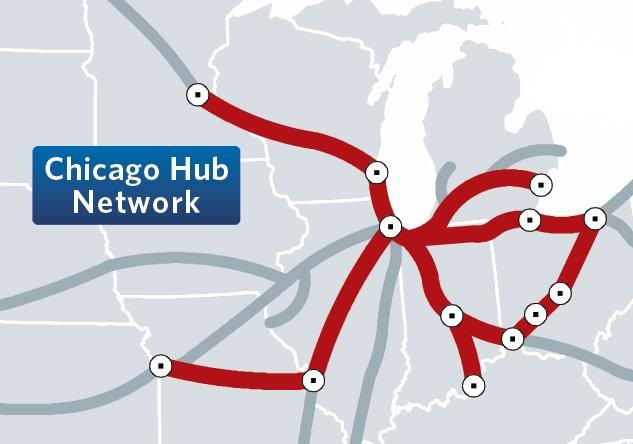
"The money will go not only to high-speed rail development but also to a parallel effort to improve rail service along existing lines ? upgrades that would allow faster train travel.
The White House said funding will move into the rail system through three channels, first to upgrade projects already approved and only in need of funding, thus providing jobs in the short term. The second and third would focus on high-speed rail planning and then a commitment to help in the execution of those plans far into the future when the stimulus funds are no longer available.
The U.S. Federal Railroad Administration says the term high-speed rail applies to trains traveling more than 90 mph (145 kph). The European Union standard is above 125 mph (200 kph)."
Wednesday, March 25, 2009
PRI Launches new website
Yes.. it has finally come. The PRI is now online and up to modern standards with its beautiful new website.
Among other things, users may
http://www.haltpoverty.org
-Kevin Lignell
Among other things, users may
- Register for volunteer opportunies
- Sign up for newsletters
- Donate directly online
- Read PRI stories
- Host poverty simulations and presentations
- Analyze poverty statistics in Kalamazoo
http://www.haltpoverty.org
-Kevin Lignell
Monday, March 16, 2009
Americorps Prepared to Expand
According to Washington Post columnist E.J. Dionne Jr., a bill to expand Americorps program from 75,000 to 250,000 volunteers appears ready to be passed by congress.
But beyond supporting myself, this bill will further aid poverty reduction efforts across the US in a extremely affordable way. Americorps are basically paid a poverty-level wage, so the cost of labor is insignificant. We also create millions of volunteers: it is estimated the current 75,000 in service responsible for creating over 2.2 million volunteers to their organizations.
Having Americorps volunteers work for the Kalamazoo County Poverty Reduction Initiative has greatly increased our capacity to fight poverty; it will certainly aid other organizations as well. I strongly recommend to anyone, young or old, this exciting opportunity to serve their country. To learn more on how to serve, visit http://www.americorps.org.
"This week, the House is expected to pass a bill that would increase the number of federally funded service slots to 250,000, and the Senate will soon begin moving similar legislation.It would also increase the education award Americorps receive from $4,725 to $5,350 and requires that it match any future increases in Pell Grant scholarships. Being an Americorps volunteer myself, obviously I have some embedded personal interest in the bill.
The House proposal won committee approval last week with overwhelming support from both parties."
But beyond supporting myself, this bill will further aid poverty reduction efforts across the US in a extremely affordable way. Americorps are basically paid a poverty-level wage, so the cost of labor is insignificant. We also create millions of volunteers: it is estimated the current 75,000 in service responsible for creating over 2.2 million volunteers to their organizations.
Having Americorps volunteers work for the Kalamazoo County Poverty Reduction Initiative has greatly increased our capacity to fight poverty; it will certainly aid other organizations as well. I strongly recommend to anyone, young or old, this exciting opportunity to serve their country.
 To learn more on how to serve, visit http://www.americorps.org.
Thursday, March 5, 2009
An in depth look at the recession
On Tuesday the New York Times asked the question: What does the worst recession in a decade look like?
Conveniently enough, they provided a map of unemployment and job losses over the last year. Beyond the map, here are some highlights of the article that accompanies it. Some conclusions were:
Our economy just went through a 50 year post war period of unheard expansion. What highlighted this expansion was a booming housing industry, a financial sector that supported the world, and until the past several decades we were a manufacturing powerhouse.
These economic strengths created one of the largest middle classes who had wide access to higher education. Reasonable class equality prevailed for many because of a combination of a strong manufacturing core and a educational system that created a large white collar workforce.
With a manufacturing core in shambles, it is important that we utilize initiatives to give low-income persons a better chance for higher education. Coupled with that, we must create incentives to re-establish manufacturing locally in the United States.
The skilled trades are suffering unheard amounts of unemployment and may NEVER recover to support the labor force they once employed. We are in a time of a shifting economy, and it is important we create pathways that transition this work force to new productive trades, whether it be gaining more education or accessing a new trade such as alternative energy.
We must act now to use the resources we can or risk a larger inequality. The suffering of the base of our economy - the workers that provide us the basic products and services we need - will lead to a decreased equity for all American consumers. In a time where our country struggles to fill other needs such as energy and healthcare, it is something we simply cannot risk.
Conveniently enough, they provided a map of unemployment and job losses over the last year. Beyond the map, here are some highlights of the article that accompanies it. Some conclusions were:
- The recession is deep and broad with every state in the country, with the exception of a band stretching from the Dakotas down to Texas, is now shedding jobs at a rapid pace.
To briefly summarize what is happening:And in opinion the most disturbing fact:
- Unlike the last two recessions — earlier this decade and in the early 1990s — this one is causing much more job loss among the less educated than among college graduates.
- The brunt of the layoffs in this recession is falling on construction workers, hotel workers, retail workers and others without a four-year degree.
- The Great Recession of 2008 (and beyond) is hurting men more than women.
- It is hurting homeowners and investors more than renters or retirees who rely on Social Security checks.
- It is hurting Latinos more than any other ethnic group.
- Though the largest pains have been suffered by the most vulnerable workers, In the long run it may end up afflicting the comfortable more than the afflicted
- Recessions often tend to increase inequality because lower-income workers are concentrated in boom-and-bust industries.
Our economy just went through a 50 year post war period of unheard expansion. What highlighted this expansion was a booming housing industry, a financial sector that supported the world, and until the past several decades we were a manufacturing powerhouse.
These economic strengths created one of the largest middle classes who had wide access to higher education. Reasonable class equality prevailed for many because of a combination of a strong manufacturing core and a educational system that created a large white collar workforce.
With a manufacturing core in shambles, it is important that we utilize initiatives to give low-income persons a better chance for higher education. Coupled with that, we must create incentives to re-establish manufacturing locally in the United States.
The skilled trades are suffering unheard amounts of unemployment and may NEVER recover to support the labor force they once employed. We are in a time of a shifting economy, and it is important we create pathways that transition this work force to new productive trades, whether it be gaining more education or accessing a new trade such as alternative energy.
We must act now to use the resources we can or risk a larger inequality. The suffering of the base of our economy - the workers that provide us the basic products and services we need - will lead to a decreased equity for all American consumers. In a time where our country struggles to fill other needs such as energy and healthcare, it is something we simply cannot risk.
Subscribe to:
Posts (Atom)

 Posts
Posts


