Showing posts with label Kalamazoo county poverty reduction initiative. Show all posts

Wednesday, November 24, 2010

A Brief Introduction to Poverty - An Opportunity to Learn

Hi, One Southwest Michigan community. My name is Paula Adams. I am a new AmeriCorps VISTA with the Poverty Reduction Initiative based in Kalamazoo County. This means I am volunteering to live with a poverty level income allowance for 12 months while I work for PRI. (With the exception of the executive director, Jeff Brown, PRI is staffed by VISTA volunteers.)

During my VISTA year I will be doing PRI's communications and public relations. Our organizational mission is to reduce poverty by collaboration, education and economic activity. My goal is to build and strengthen relationships between PRI and our local, state and national partners. Please visit haltpoverty.org for more information about the Kalamazoo PRI.

I am grateful to have this opportunity, both personally and professionally. If any of you have seen the movie "Inception" written and directed by Christopher Nolan, one way to know you're not dreaming is by asking "How did I get here?" It's probably something many of the 43+ million Americans who live in poverty ask themselves every day. Unfortunately, they are not dreaming.

Here's the short version of my own answer:

Three months ago I had no idea that AmeriCorps existed. (AmeriCorps is the "stay-at-home" domestic sister of the global more "popular" Peace Corps.) In September the contract for my temporary workforce development position was ending and my own future was uncertain. I wanted to go back to marketing and communications work, but jobs are scarce and competition is tight. One lucky email from a colleague with this job posting changed my future, opening the AmeriCorps door, so to speak. Here I am today, my first week in the office, sworn into national service and just beginning to learn about poverty related issues.

Choosing AmeriCorps service was an easy decision and a difficult one. Is the work needed? Yes. Poverty rates have been increasing, not decreasing, up to 14.3% in 2009, according to the Census Bureau. We want to change that. But after all, who chooses to live in poverty? This is a big question on many levels. Do people actually choose poverty? Is our society choosing poverty? If so, why? What exactly is poverty, anyway? Is poverty merely living on a small income or is it something else?

These are some of the questions I have starting out. Maybe you share some of these questions. I'd like to hear from you. I see this blog as a forum to discuss the questions, answers, and explore potential solutions to the very real problems that result from poverty - hunger, homelessness, difficulty getting and/or keeping a job, the inability to provide opportunities for our children.

I believe we can only solve these problems together, as a community - local, national, global. I'd love to hear what solutions work in your area, in your household, in your state, in your nation. How can we help and empower each other to be prosperous and successful, whatever that means to us as individuals? I invite you to share your successes and your lessons learned. If you'd like to contribute a post, let me know.


Thank you for allowing me my voice as a "temporary" resident here. I am honored to do this work, and have a lot to learn. I will be challenged into new ways of thinking, of relating, and of strategizing in this job. As I learn, I will share with you whatever insights I gain, whether they be wise or foolish. I hope that you, my reader, will comment, contribute, and teach me in return. I am grateful to have you as a reader and a teacher.

Happy Thanksgiving. May you experience bounty and abundance for the day and the upcoming year.


Monday, June 15, 2009

Can Stimulus help turn the tide? Job losses, plant closes and budget cuts running amuck

The Kalamazoo Gazette reported a feature on the joblessness in Southwest Michigan this weekend. In Kalamazoo, the unemployment rate of 9.7% is up 70% from last year.

The Gazette interviewed a cross-section of the community and found many poignant stories that brought the stark numbers to life. Not surprisingly, many we talked with were reluctant to share publicly their personal tales.

A single mother who previously earned more than $60,000 a year moved to Kalamazoo from out of state to care for a sick parent. She left behind more than a job -- she lost her home, her car, and some of her pride. She now lives with that parent, is supported by that parent and has only found occasional part-time employment.

Then there's the married father of two who was downsized out of his career after 32 years. A family member offered him a job out of state, but he can't sell his home for a large-enough sum to cover the mortgage. And not only does he feel stuck, his wife's job could be on the chopping block. Without her job, the family loses its health insurance, a devastating possibility considering one of their daughters is ill and recently moved back home.

These reports are all to familiar for many of us who have felt the job losses among our friends and families first hand. In addition, a plant in South Haven will close sometime this month leading to the loss of some 279 jobs. This is a significant loss considering South Haven only has 1,070 industrial jobs total, meaning it only 2/3 of those jobs will remain after the closing. Though local officials are working to diversify the community, it will take some time to restore losses this large.

Meanwhile, teachers who cannot afford to retire are disrupting school budgets. Sixteen teachers are retiring from Kalamazoo Public Schools, less than half the usual number. A state buyout planned that failed early this month has limited financial flexibility of those wanting to retire. This adds to budget woes already faced by some schools - Portage schools are now poised to cut teachers, buses and custodians in an effort to balance their budget.

There is some hope on the horizon as Joe Biden's visit to the region announced a new federal bond program that could inject $102 million into Southwest Michigan's economy. The plan could allow government and private businesses in Michigan to sell $2 billion in bonds. Kalamazoo County could get $46.1 million; Allegan County, $18.9 million; Cass County, $9.9 million; St. Joseph County, $14.0 million; and Van Buren County, $13.5 million, according to the U.S. Treasury.
The program has two types of bonds. Recovery Zone Facility Bonds give private businesses a low-cost way to finance capital projects such as building a hotel or manufacturing plant, according to the U.S. Treasury Department. Recovery Zone Economic Development Bonds allow state and local governments to finance projects such as infrastructure improvements or job-training and educational programs.
Good news to give support to development in SW Michigan that has been halted if not reduced over this economic downscale. Regardless, the PRI has its work cut out for it in the coming months.

Tuesday, May 26, 2009

Community Service Database Making Progress

The city of Kalamazoo is one step closer to having a streamlined system that organizes the areas major human services into one, decipherable database. While systems like the 211 and Kalamazoo Library's Public Library's Local Information Directory do excellent work in directing residents to services the they need, there appeared to be a large gap between the two databases in establishing one, comprehensive resource for the community.

The Poverty Reduction Initiative, in collaboration with WMU's Lewis Walker institute, saw this as valuable opportunity to improve upon the services that currently exist. Instead of recreating an entire network, the PRI is working with both 211 and the Kalamazoo library to consolidate these two databases in to one, making it easier for residents to access it. We are also looking to improve upon the navigational methods, making the it easier to search and find resources in need.

A great example of resource mapping is the Washington DC's Food Finder, which uses google maps to locate services closes to where a person resides. Where the Kalamazoo database will differ is that it will service areas beyond food help to its residents, making it even more valuable to residents.

Mapping this complicated and scrambled maze of services will not be easy, but the results will surely be realized in there impact upon both residents and human service organizations. Having this database will not only allow residents to access them easier, but also allow for service organizations that already exist to better understand where to direct their time and energy.

Look forward to seeing more updates on the database this fall, where the research will begin to transform into a interface for the Kalamazoo community.

Monday, May 18, 2009

A sign of the Times: More Home Break-ins Happening in Kzoo


According to the Kalamazoo Gazette:

"Home break-ins last year in the city increased 8.8 percent, to 876, compared to 805 in 2007. Also, the Public Safety Department has seen an increase in home break-ins this year compared to the same period last year, Lt. Scott Merlo said.

The total number of home break-ins reported by Kalamazoo city, Kalamazoo County, Kalamazoo Township and Portage police -- the four largest law-enforcement agencies in the county -- was up 6.5 percent, to 1,802, in 2008. That figure is nearly identical to the 1,797 break-ins reported by those agencies in 2006."
The Edison Neighboorhood had the highest number of home break-ins with 498. Vine Neighborhood ranked second with 417 break-ins.

I think there is a reason why break-ins occurred so heavily in these areas rather than others. I think one reason the high volume of apartments and low-income housing, preferable chosen by students, that occurs in especially in the Vine neighborhood. As recently being one, I know that students often have valuable items such as electronics and do not always protect their living spaces as dutifully as others. Hence, they become an easy target for crime in an area which is easily accessible from downtown. The houses there are old and not the most secure.

My other guess for Edison neighborhood could be associated with the poverty-rate, where I have learned through poverty simulations that persons in poverty are often vulnerable because they do not always have the time or resources to make their home environments safe and secure. They become easy victims for thieves, as one woman in the article was robbed 9 times in a 3 year span.

With economic activity stifled and prisons overcrowded, no wonder crime is on the rise. Once imprisoned, it is very difficult a person to find work in the community. Having a prison sentence is a stigma which deters employers from hiring. Unable to find any work, many resort back to committing the profitable crimes that landed them in prison the first time.

This is exactly why we must advocate for prisoner re-entry programs - job placement programs which give former inmates opportunities to earn a living wage. These type of programs are effective at deterring former law-breakers from repeating their crimes. Advocating for this program could potentially significantly lower crime such as break-ins in cities such as Kalamazoo.

Monday, May 11, 2009

Monday Round-up

News Highlights:

State budget cuts hit home in Southwest Michigan
As the dust begins to settle on $349 million in state budget cuts ordered last week, the local impact is beginning to sink in -- from state trooper posts to county fairs to local health departments. The Kalamazoo Gazette breaks down what the budget cuts will have in store for Southwest Michigan, including the topics of: state police, human services, healthy care, agriculture & county fairs, the arts, and revenue sharing.

Carrier to Discontinue Tyler Brand Line and Close Plant in Niles, Michigan
The previous article speaks about how Berrian County has been able to weather the storm better than other areas in SW Michigan. That was before it was announced that 500 jobs were to be cut in by the closing of a plant in Niles. These are huge job losses for a city with a population of only 11 thousand residents.

More on the story: News of Tyler Refrigeration closing is 'devastating'


Which is our kind of town?
Article debates on whether Southwest Michigan is more like Chicago or Detroit.

Volunteers begin building playground for kids at Kalamazoo's Peace House
PRI Americorps Maggie Haitt and Ernest Cawvey helped make the improvements at the Peace House that the article speaks about.

Monday, May 4, 2009

May 5th: Vote nears for Public Transit, Public library

On Tuesday, May 5th voters will decide upon whether to renew two mileages - one for the public transit system in Kalamazoo and the other to support the public libraries. These mileages both have extreme importance to the vitality of residents in Kalamazoo County.

The Poverty Reduction Initiative supports both Mileages as both services play large roles in reducing negative effects of poverty such as: increased mobility, access to goods and services, access to educational resources, access to digital media, and much more.

Many people inside both the city of Kalamazoo and the county use the public transit system to reach their employers, visit educational programs, receive goods and services, and stay connected within their community. Getting rid of this service not only hurts these residents, but also degrades the overall economic well-being of the region.

Many are familiar with the educational and economic advantages of having a public library with effective services. This resources increases resident literacy, technological skills and even employment skills.

Please take a moment on May 5th to vote yes for both proposals. The cost of these services is negligible juxtaposed to the benefits they provide to our community.


Monday, April 27, 2009

USA Rates 3rd Highest Poverty Rate Among OECD Nations for 2009


The OCED stands for organization for economic co-operation and development and compares a list of basically modernized, industrial countries. When compared, the USA has a rate of poverty only outmatched by Mexico and Turkey. Ouch.

Relative income poverty is measured here by the poverty rate and the poverty gap. The poverty rate is the ratio of the number of people who fall below the poverty line and the total population; the poverty line is here taken as half the median household income. However, two countries with the same poverty rates may differ in terms of the income-level of the poor.

What isn't even mentioned in the article is the United States outdated calculation of the poverty rate, which doesn't factor in such costs here as transportation and healthcare and relies mostly on overcompensated food costs. While many of the European countries have adequate welfare services listed, the USA's are mediocre at best.

Worst of it, the rate is growing. This is a nation-wide phenomenon that needs to be addressed on a wide-scale.

Wednesday, April 22, 2009

The Poverty Business: Taking Advantage of the Poor

An article from Business Weekly today spoke about businesses who take advantage of the poor in the US. It is also an insight on how we got into this economic mess. More and more companies gave out riskier and riskier loans to people who obviously couldn't afford to pay them back: When prices started to rise, they stopped paying, and these companies in turn lost profit.

Some highlights from the Article:
In recent years, a range of businesses have made financing more readily available to even the riskiest of borrowers. Greater access to credit has put cars, computers, credit cards, and even homes within reach for many more of the working poor. But this remaking of the marketplace for low-income consumers has a dark side: Innovative and zealous firms have lured unsophisticated shoppers by the hundreds of thousands into a thicket of debt from which many never emerge.

The recent furor over subprime mortgage loans fits into this broader story about the proliferation of subprime credit. In some instances, marketers essentially use products as the bait to hook less-well-off shoppers on expensive loans. "It's the finance business," explains Russ Darrow Jr., a Byrider franchisee in Milwaukee. "Cars happen to be the commodity that we sell." In another variation, tax-preparation services offer instant refunds, skimming off hefty fees. Attorneys general in several states say these techniques at times have violated consumer-protection laws.
What is really interesting are some of the methods that these companies use to take advantage of the poor. A story from New Mexico details how no-credit used car salesmen make their efficient profits:

Nearly half of Byrider sales in Albuquerque do not result in a final payoff, and many vehicles are repossessed, says David Brotherton, managing partner of the dealership. A former factory worker, he says he sympathizes with customers who barely get by. "Many of these people are locked in a perpetual cycle" of debt, he says. "It's all motivated by self-interest, of course, but we do want to help credit-challenged people get to the finish line."

Byrider dealers say they can generally figure out which customers will pay back their loans. Salesmen, many of whom come from positions at banks and other lending companies, use proprietary software called Automated Risk Evaluator (ARE) to assess customers' financial vital signs, ranging from credit scores from major credit agencies to amounts spent on alimony and cigarettes.

Unlike traditional dealers, Byrider doesn't post prices—which average $10,200 at company-owned showrooms—directly on its cars. Salesmen, after consulting ARE, calculate the maximum that a person can afford to pay, and only then set the total price, down payment, and interest rate. Byrider calls this process fair and accurate; critics call it "opportunity pricing."


So how did Byrider figure that Tsosie had $300 a month left over from her small salary for car payments? Barely a step up from destitution, she now lives in her own cramped apartment in a dingy two-story adobe-style building. Decorated with an old bow and arrow and sepia-tinted photographs of Navajo chiefs, the apartment is also home to her new husband, Joey A. Garcia, a grocery-store stocker earning $25,000 a year, his two children from a previous marriage, and two of Tsosie's kids. She and Garcia are paying off several other high-interest loans, including one for his used car and another for the $880 wedding ring he bought her this year.

Asked by BusinessWeek to review Tsosie's file, Byrider's Brotherton raises his eyebrows, taps his keyboard, and studies the screen for a few minutes. "We probably should have spent more time explaining the terms to her," he says. Pausing, he adds that given Tsosie's finances, she should never have received a 24.9% loan for nearly $8,000.

That still leaves her $900 in Byrider's till. "No excuses; I apologize," Brotherton says. He promises to return the money (and later does). In most transactions, of course, there's no reporter on the scene asking questions.

Even major banks and financial instutions have recognized the new market of working poor. Wells Fargo & Co. (WFC ) and U.S. Bancorp (USB ) now offer their own versions of payday loans. :

Mainstream financial institutions are helping to fuel this explosion in subprime lending to the working poor. Wells Fargo & Co. (WFC ) and U.S. Bancorp (USB ) now offer their own versions of payday loans, charging $2 for every $20 borrowed. Based on a 30-day repayment period, that's an annual interest rate of 120%. (Wells Fargo says the loans are designed for emergencies, not long-term financial needs.) Bank of America's revolving credit line to Byrider provides up to $110 million. Merrill Lynch & Co. (MER ) works with CompuCredit to package credit-card receivables as securities, which are bought by hedge funds and other big investors.

Once, major banks and companies avoided the poor side of town. "The mentality was: Low income means low revenue, so let's not locate there," says Matt Fellowes, a researcher at the Brookings Institution in Washington, D.C. Now, he says, a growing number of sizable corporations are realizing that viewed in the aggregate, the working poor are a choice target. Income for the 40 million U.S. households earning $30,000 or less totaled $650 billion in 2004, according to Federal Reserve data.
Very interesting read, and an insightful piece of what has been wrong with this country for the last few decades of wealth abuse. The article covers more angles including credit cards and other lending methods. Check out the entire article if you have a chance.

Monday, April 20, 2009

Apparently, Debtors Prisons Have Returned


A couple weeks ago, the New York Times reported on a recent phenomenon happening around the United States: Imprisonment for debt. Here's a segment from the story:

"Here is a tale that sounds like it comes right from the pages of “Little Dorrit,” Charles Dickens’s scathing indictment of VictorianEngland’s debtors’ prisons. Unfortunately, it is happening in 21st-century America.

Edwina Nowlin, a poor Michigan resident, was ordered to reimburse a juvenile detention center $104 a month for holding her 16-year-old son. When she explained to the court that she could not afford to pay, Ms. Nowlin was sent to prison. The American Civil Liberties Union of Michigan, which helped get her out last week after she spent 28 days behind bars, says it is seeing more people being sent to jail because they cannot make various court-ordered payments. That is both barbaric and unconstitutional.

In 1970, the Supreme Court ruled that it violates equal protection to keep inmates in prison extra time because they are too poor to pay a fine or court costs. More recently, the court ruled that a state generally cannot revoke a defendant’s probation and imprison him for failing to pay a fine if he is unable to do so."
The article later concludes:
"Prisoners’ rights advocates worry that in these hard times, when government budgets are under pressure, courts and prisons will get even tougher about forcing indigent defendants to pay costs and fees, and will imprison more of them if they cannot come up with the money. The government should be helping people on society’s margins build productive lives. Throwing them in jail for being poor makes that much more difficult."
This is a scary and sobering story, of which its main example inexcusably comes from our state! I always assumed this was one of our most basic rights; I guess some governmental bodies are in disagreement, brought on by very desperate times. I hope we can get past these archaic methods - jailing someone impoverished is a quick way to inflame the problem, not a solution to state budget woes.

It certainly serves as an example, albeit an extreme one, to the complexity of economic struggles in both our state and America as a whole. We need to pull together our resources now and unite, not fight the poorest population for every last dollar.

Friday, April 17, 2009

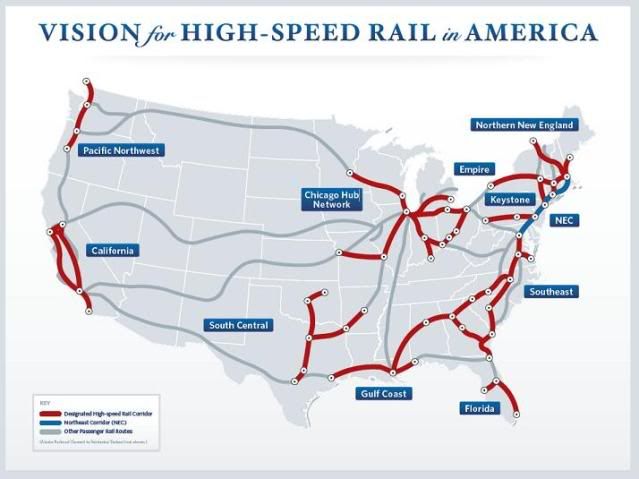
Obama Administration's Vision for a High Speed Rail

This week the Obama Administration revealed its plans for a system of high speed rail in major America regions. Courtesy of West Michigan Rising, the administration has mapped out several areas across the country it hopes to improve:

"President Obama's vision for high-speed rail mirrors that of President Eisenhower, the father of the Interstate highway system, which revolutionized the way Americans traveled. Now, high-speed rail has the potential to reduce U.S. dependence on foreign oil, lower harmful carbon emissions, foster new economic development and give travelers more choices when it comes to moving around the country."
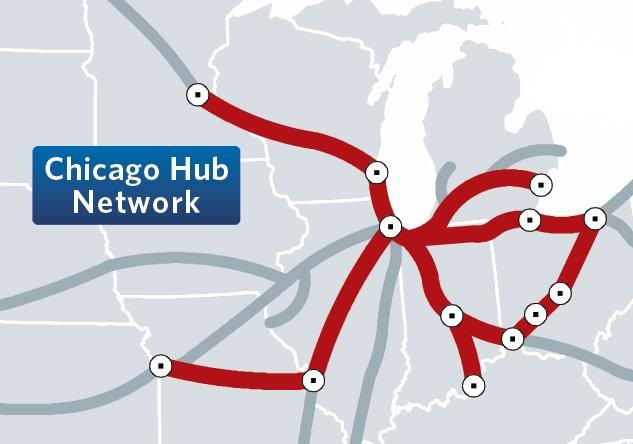
The administration is focusing intently on the Midwest region, where it hopes to connect major cities in the area with the economic hub of Chicago. Which cities would it include as stops on this train? Only time will tell, but I'm sure some of it will be up to us as citizens to promote our cities as ideal stops.

Per the Gazette:

"The money will go not only to high-speed rail development but also to a parallel effort to improve rail service along existing lines ? upgrades that would allow faster train travel.

The White House said funding will move into the rail system through three channels, first to upgrade projects already approved and only in need of funding, thus providing jobs in the short term. The second and third would focus on high-speed rail planning and then a commitment to help in the execution of those plans far into the future when the stimulus funds are no longer available.

The U.S. Federal Railroad Administration says the term high-speed rail applies to trains traveling more than 90 mph (145 kph). The European Union standard is above 125 mph (200 kph)."

Monday, April 13, 2009

Kalamazoo Promise Still in Need of Comprehensive Vision

The Kalamazoo Promise was a popular topic over the weekend, featured in two Gazette articles. One basically spoke about how it is still holding on in tough times, the other about a new book published about the Promise, which speaks about the difficulties and challenges faced by the Promise.

Many are coming to realize that even though the project has created something truly ground-breaking and inspirational, we still have a long way to go until the true dream of its ideals are actualized.

There is no comprehensive plan to make the Promise a collective community program; it still only exists as an argument for an economic vehicle for college tuition. Until people realize that it will take much more community action to make this program successful, it will continue to raise doubts and suspicions.

The Kalamazoo Promise will not create direct change on its own; it needs to support the children and families in order for them to succeed. As I wrote in a previous post, the Developmental Assets model would be an excellent place to start:

Developmental Assets are common sense, positive experiences and qualities that help influence choices young people make and help them become caring, responsible adults. Studies of more than 2.2 million young people in the United States consistently show that the more assets young people have, the less likely they are to engage in a wide range of high-risk behaviors and the more likely they are to thrive. Assets have power for all young people, regardless of their gender, economic status, family, or race/ethnicity. Furthermore, levels of assets are better predictors of high-risk involvement and thriving than poverty or being from a single-parent family.

We have the opportunity to create a comprehensive vision by plugging in a model that already WORKS and using it to our advantage here in Kalamazoo.

Friday, April 10, 2009

10 Reasons Why You Should Vote Yes for the Public Transportation Mileage in Kalamazoo


1. Our public transportation helps keep people in productive jobs and preparing for productive jobs, with two-thirds of riders using the services for work or school.

2. Our public transportation system is an important factor in the overall viability of our local and regional economy, with high-tech employers saying having a public transportation system is “very important” for business location and re-location.

3. Our public transportation system is a collaborative, inter-connected network that coordinates bus routes
with demand/response service, reducing duplication of services.

4. Our public transportation system provides more than three million rides per year in Kalamazoo County.

5. Our public transportation system is well utilized, providing more than 70 percent more rides than it did a decade ago.

6. Our public transportation system provides well-known, documented environmental and economic benefits to the community, state and nation, including cleaner air, less traffic congestion and decreased reliance on foreign oil

7. Our public transportation system transports elderly and disabled citizens to receive important services throughout Kalamazoo County.

8. Our public transportation system helps individuals who can’t afford private transportation to medical appointments, meetings and life-enriching experiences.

9. Our public transportation system will require only four-tenths of one mill for four years outside the City of Kalamazoo, less than the levy that expired at the end of 2008 for out-county residents.

10. Our public transportation system will require one mill within the City of Kalamazoo, the same as that approved by voters in 1998 and less than that approved by city voters in 2006.

The vote takes place in the city of Kalamazoo on Tuesday May 5th, 2009.

Monday, April 6, 2009

Developmental Assets: A Potential Template for Community Covenants

At the VISTA training last month in Ypsilanti, I was privileged to see a presentation on the Developmental Asset Model for children conducted by the Search Institute. I was so inspired by the research that when I returned to Kalamazoo I told our director Jeff Brown about what I had learned. It turned out that Jeff was already certified in Developmental Assets and wanted to implement that idea into our community covenant to support the Kalamazoo Promise.

From the Search Institute website:

Developmental Assets are common sense, positive experiences and qualities that help influence choices young people make and help them become caring, responsible adults. Studies of more than 2.2 million young people in the United States consistently show that the more assets young people have, the less likely they are to engage in a wide range of high-risk behaviors and the more likely they are to thrive. Assets have power for all young people, regardless of their gender, economic status, family, or race/ethnicity. Furthermore, levels of assets are better predictors of high-risk involvement and thriving than poverty or being from a single-parent family.
There are forty identified Developmental Assets, which are broken down into external and internal assets. External assets include the categories of support, empowerment, boundaries and expectations, and constructive use of time. Categories of Internal assets include commitment to learning, positive values, school competencies, and positive identity. The individual assets vary upon the age group of the children, but all include these basic categories. You can view each of them on their website:

Early Childhood (ages 3-5)
Middle Childhood (ages 8-12)
Adolescents (ages 12-18)

One of the great pieces of this model is that it stresses programs that center on relationship building and valuing youth, rather than simply implementing new programs. It has the potential to be a great resource when the community is ready to create a covenant to encompass the new vision of Kalamazoo. If we build our model this innovative research, it could have the potential to affect a great number of children and families in Kalamazoo

Thursday, April 2, 2009

Gilmore Museum Aims to Reach Out to Disadvantaged Youths


Disadvantaged teenagers could have the opportunity this summer to work with antique cars, and get paid for their efforts. The PRI is working with the Gilmore Car Museum near Richland to coordinate an educational program that would support low-income teenagers.

Using the Summer Youth Employment program, it has an opportunity to be both a educational experience and a well-paying job. Tim Morris, Gilmore's Director of Education, has experience leading programs at the Kalamazoo Air Zoo. He already has developed an in depth curriculum that meets state level standards. Additionally, the program is intended to excite and prepare these youths to enter car maintenance programs, such as the highly respected one at Kalamazoo Valley Community College.

The only barrier is finding the right source of youth employment to foster the program. With the Gilmore being just over county bounders, they can not access the large stimulus money for teens being poured into the Summer Youth Employment program. However, if they can access the program through Barry County, they have a great opportunity to employ youths and give them an opportunity to succeed in the future.

Wednesday, April 1, 2009

Summer Offers More Jobs for Disadvantaged Youths in Kalamazoo

For disadvantaged youths who would otherwise have little to do this summer, hope is arrived in the form of a $800 thousand stimulus supplement for employment this summer. Hundreds of youths ages 14-24 who are low-income now have the opportunity to have a meaningful and educational experience this summer employed in a non-profit in Kalamazoo.

The stimulus money provides the recruitment, administrative, and training costs associated with hiring. Non-profits who need staff will be asked to take on these workers free of charge - as long as they can find them meaningful work to do. This comes in additional to an estimated $300 thousand dollars which will be raised by city officials - coming to a total of over a million dollars in youth employment funds.

So the great task begins of finding opportunities that will not only keep youths, busy but also show them the value of steady employment and engage them in an opportunity to learn. Sure, you can put a bunch of workers in a park to pick up trash, but the experience may do little to actually change their outlook on life. We need experiences that will be transformational for these youths so that they use them to be more successful in the future.


If you administer a non-profit who is looking to have an educational opportunity or employment opening this summer, consider staffing your agency with the summer youth program. Contact Cincy Sullivan 269-383-2536 x 117 or csullivan@kresa.org

Wednesday, March 25, 2009

PRI Launches new website

Yes.. it has finally come. The PRI is now online and up to modern standards with its beautiful new website.

Among other things, users may
  • Register for volunteer opportunies
  • Sign up for newsletters
  • Donate directly online
  • Read PRI stories
  • Host poverty simulations and presentations
  • Analyze poverty statistics in Kalamazoo
Please take your time, look around and enjoy!

http://www.haltpoverty.org

-Kevin Lignell

Monday, March 23, 2009

Could Kalamazoo be home to an Educare center?


What's a best way to make sure our youth grow up with the highest chance of success? Support them when the are young and most vulnerable. That's what successful Educare centers across the United States are doing to give their at-risk children the best chance of succeeding. Their goal: to dramatically improve the quality in programming for early children and create a platform for broader policy change.

Educare centers are state-of-the-art early childhood centers designed to meet the needs of today's families who are making the transition from welfare to work and are recipients of a mix of Head Start, child care and preschool services. They serve 150-200 of their community's at-risk children (birth to 5 years) and their families. Each classroom provides a BA-degreed teacher, an assistant teacher with a AA degree, and an aid from the community. All classrooms are supervised by teachers with Master's degrees in early childhood.

So why haven't we implemented one of these innovative ideas already? Basically, its purely a financial motive: Educare centers cost around $4-5 million to build and nearly $2-3 million each year to maintain. We simply haven't allocated the resources for such a project, though of large foundations are willing to help, it wouldn't be difficult to attract the funds. Organizations such as the Gates Foundation have contributed to projects on equal scale in the past and could be a possible avenue for the future.

Kalamazoo has the unique opportunity of already having an amazing program, the Kalamazoo Promise, in place to garner support for of these centers. What better argument that to suggest that our program is not the only solution but a perfect place to start for MORE programming to ensure our children have the best possible future. We are already a model for how to make education a real possibility for every child; lets make sure that they are supported from their earliest times of learning.

Monday, March 16, 2009

Americorps Prepared to Expand

According to Washington Post columnist E.J. Dionne Jr., a bill to expand Americorps program from 75,000 to 250,000 volunteers appears ready to be passed by congress.

"This week, the House is expected to pass a bill that would increase the number of federally funded service slots to 250,000, and the Senate will soon begin moving similar legislation.

The House proposal won committee approval last week with overwhelming support from both parties."
It would also increase the education award Americorps receive from $4,725 to $5,350 and requires that it match any future increases in Pell Grant scholarships. Being an Americorps volunteer myself, obviously I have some embedded personal interest in the bill.

But beyond supporting myself, this bill will further aid poverty reduction efforts across the US in a extremely affordable way. Americorps are basically paid a poverty-level wage, so the cost of labor is insignificant. We also create millions of volunteers: it is estimated the current 75,000 in service responsible for creating over 2.2 million volunteers to their organizations.

Having Americorps volunteers work for the Kalamazoo County Poverty Reduction Initiative has greatly increased our capacity to fight poverty; it will certainly aid other organizations as well. I strongly recommend to anyone, young or old, this exciting opportunity to serve their country.To learn more on how to serve, visit http://www.americorps.org.

Thursday, March 12, 2009

Transportation Still a Major Issue for those in Poverty


Transportation issues have always been a source of frustration for anyone who has experienced poverty. In a country dominated by the automobile for the past century, it is a large obstacle for anyone trying to make it to work on a weekly basis on top of accessing the support services that a low-income person needs to survive.

Cars are expensive - from their initial cost to purchase, to the high-priced gasoline they consume, to the burdening cost of repair. For someone making minimum wage who has a family, the cost can be crippling. For many in poverty, they simply cannot afford the cost associated with an automobile.

If you aren't driving around to get to where you need to be, then you have to rely on either friends or public transportation. Public transportation, while strong in some major cities in the country, is completely unreliable in Michigan. In our cities, at most what is available is a scattered system of buses which do not even serve all the relevant population areas.

Anyone who's ever ridden a bus to get someone knows how difficult their routes can be to traverse. If you don't live near a route, or if that route does not lie where you need to go, you can forget about an easy travel. It could take 3-4 hours a day to reach what a car would feasibly do in 30 minutes.

What we need to mend the struggles of public transportation is a system of both light rail and high speed trains. This would make it easier for any residents, regardless of income, to access the resources around them. It would also be environmentally friendly, reducing pollution and increasing mobility of the region.

In the Michigan Business Review, writer Nathan Bomey asks if a high speed train could be in Michigan's future.

In fact, the Windy City is the top thief of Michigan's top college graduates, according to Ann Arbor-based think tank Michigan Future.

Which is just part of the reason why he believes high-speed rail could provide a significant boost to the region. If young people could visit Chicago regularly, why not stay in Michigan after all? Not to mention the fact that high-speed rail could introduce a wave of new people to the Detroit region.

For now, though, high-speed rail is still largely a fantasy for most of the country. The sheer amount of investment needed - tens of billions of dollars for hundreds of miles of track and trains - is daunting.

But the Obama administration's commitment to enhancing the nation's transportation infrastructure and the inclusion of $8 billion in high-speed rail funding in the $787 billion economic stimulus package are promising steps.

Rick Harnish, executive director of the Chicago-based Midwest High-Speed Rail Association, argued that Michigan needs high-speed rail.

"I don't see how Michigan remains in the global marketplace if it doesn't link itself to fast trains with Chicago," he said.

Please add Kalamazoo to the list of High Speed stops in this senario. For a city who prides it self in being the transition from Chicago to Detroit, this would reap millions for the economy. So what's holding all this potential economic development back?

Ultimately, the barriers to high-speed rail present significant obstacles, though. Freight carriers own most existing tracks, for example, meaning Amtrak trains have to yield to freight trains during routine trips.

Harnish said high-speed rail investments would require the construction of new tracks to avoid freight trains as much as possible and renegotiation of deals with freight companies.

We need to make these forms of transportation a priority again. It simply isn't feasible to rely on hybrid car development to push the future - the roads are crowded and potential slower than a train anyway. The development of trains in Michigan would help both its poverty residents as well as those well-off.

Monday, March 9, 2009

Analyzing Southwest Michigan's Potential to be a Research Model

Several months ago after several meetings with leaders and collaborators of the nine counties of Southwest Michigan, the collation of organizations accepted a plan to bring about a community indicators database in Southwest Michigan. The database would essentially take data from the service providers in the region to create a comprehensive analysis of what works and where there are necessary gaps that need to be filled in the fight to reduce poverty.

Soon afterwords, the combined efforts of the Lewis Walker Institute and the Kalamazoo County Poverty Reduction Initiative secured a significantly-sized grant to fund their efforts. When PRI and Lewis Walker representatives recently met with state poverty officials to discuss the state's direction in poverty reduction, they found many similarities in their plans. In turn if the model for Southwest Michigan could be successfully adapted, it is quite possible that the region could plan a lead role in poverty research on both a state and federal level.

There are several other factors why the region would be an ideal model for poverty reduction:
  • The diversity in the socioeconomic status of its citizens
  • The mix of both urban (Kalamazoo, Battle Creek, Benton Harbor) and rural populations of residents
  • Its basically neutral position in state political affluence
  • The success of already standard programs such as the Kalamazoo Promise
  • The resources and leadership already available through the Lewis Walker Institute and PRI
  • The cooperation between counties that the region has already demonstrated.
With all these factors considered, the future for a collaborative framework of poverty reduction in the region seems very positive. If we can work together and effectively create an effective system of community indicators, we might not only improve our local communities but have an affect on distant states as well.