Wednesday, May 6, 2009

Kalamazoo voters pass Transit, Public Library Mileages


I want to thank all the Kalamazoo Voters who came out yesterday and helped pass the Public Transit & Public Library Mileages. Voters overwhelmingly passed both mileages, renewing the transportation & educational services which are vital to so many residents of Kalamazoo County.

The public transit vote will fund buses outside Kalamazoo, as well as Metro Van and Care-A-Van. Care-A-Van aids many senior citizens and people with disabilities reach the services they need.

Step two is to put a 0.6-mill tax request before Kalamazoo city voters on the November ballot.

Monday, May 4, 2009

May 5th: Vote nears for Public Transit, Public library

On Tuesday, May 5th voters will decide upon whether to renew two mileages - one for the public transit system in Kalamazoo and the other to support the public libraries. These mileages both have extreme importance to the vitality of residents in Kalamazoo County.

The Poverty Reduction Initiative supports both Mileages as both services play large roles in reducing negative effects of poverty such as: increased mobility, access to goods and services, access to educational resources, access to digital media, and much more.

Many people inside both the city of Kalamazoo and the county use the public transit system to reach their employers, visit educational programs, receive goods and services, and stay connected within their community. Getting rid of this service not only hurts these residents, but also degrades the overall economic well-being of the region.

Many are familiar with the educational and economic advantages of having a public library with effective services. This resources increases resident literacy, technological skills and even employment skills.

Please take a moment on May 5th to vote yes for both proposals. The cost of these services is negligible juxtaposed to the benefits they provide to our community.


Friday, May 1, 2009

Eastside Leaders Step Up for Poverty March

After speaking with Eastside Neighborhood leaders, talks have progressed to initiate a poverty march this fall. Focusing on creating awareness around poverty issues, the march will highlight recent victories on the Eastside Neighborhood as well as opportunities for improvement.

Ideally, the walk would become an annual event. Each year it would change its focus to a different neighborhood, highlighting new victories and opportunities for improvement for each. Participants would literally walk through the neighborhood, being able to experience first-hand what it feels like.

We will press local leaders to be available for speeches and conversations with residents, creating a dialog that will bring the community together and access innovative minds to create improvements.

Look for more information towards the end of summer - the event is tentatively scheduled for early fall.

Wednesday, April 29, 2009

Southwest Michigan Farmers Market Season Starts Saturday


I Thought I would brighten up the blog with exciting news for all those who love local fresh foods and vegetables! One of my favorite programs in Kalamazoo allows food Aid recipients, such as Americorps like my self, to exchange their EBT balance into credits for the Farmer's Market.

You can exchange your debit dollars for tokens at the Kalamazoo People's Food Co-op, located at 436 Burdick Street in Downtown Kalamazoo. It is a great way for low-income for aid recipients to access healthy and nutritious food without the hassle.

Here is a list of Farmer's Market openings via the Kalamazoo Gazette:

Kalamazoo Farmers Market, 1204 Bank St. -- Opens Saturday and will be open from 7 a.m. to 2 p.m. Saturdays through Nov. 21 and 7 a.m. to 2 p.m. Tuesdays and Thursdays from June to October.

Otsego Farmers Market, in the Church of God parking lot at the corner of M-89 and Kalamazoo Street -- Opens Saturday and continues from 8 a.m. to 1 p.m. Saturdays through the end of October.

People's Food Co-op Farmers Market, in the Co-op parking lot, 436 S. Burdick St. -- Opens May 6 and will be open from 3 to 7 p.m. Wednesdays through October.

Allegan Farmers Market, in the parking lot at the corner of Cutler and Water streets -- Opens May 7 and continues from 8 a.m. to 2 p.m. Thursdays through the end of October.

Mendon Farmers Market, Reed Riverside Park Pavilion, on South Nottawa Road, a half block south off of M-60 -- Opens May 7 and continues from 2 to 6 p.m. Thursdays through September.

South Haven Farmers Market, in the Huron Street parking lot in downtown South Haven -- Opens May 9 and will be open from 8 a.m. to 2 p.m. Saturdays through October and Wednesdays from June 3 through October.

Texas Corner Farmers Market, 7110 West Q Ave. -- Opens May 23 and will be open from 8 a.m. to noon Saturdays through Oct. 4.

Three Rivers Farmers Market, in Scidmore Park, corner of West Michigan Avenue and Spring Street -- Opens May 23 and continues from 8 a.m. to noon Saturdays through October.

Richland Farmers Market, at Richland Area Community Center, 9400 East CD Ave. -- Opens June 3 and continues from 3:30 to 6:30 p.m. Wednesdays through October.

Wayland Area Farmers Market, in Wayland City Park, between Park and Church and East Cherry and East Maple streets -- Opens June 6 and continues from 9 a.m. to 2 p.m. Saturdays through October.

Saugatuck-Douglas Greenmarket, in front of the Saugatuck Center for the Arts, 400 Culver St. -- Opens June 12 and continues from 8 a.m. to 2 p.m. Fridays and 3 to 7 p.m. Mondays through Oct. 12.

Lawrence Farmers Market, in downtown park along Red Arrow Highway -- Opens July 11 and continues from 9 a.m. to 1 p.m. Saturdays through Oct. 10.

Monday, April 27, 2009

USA Rates 3rd Highest Poverty Rate Among OECD Nations for 2009


The OCED stands for organization for economic co-operation and development and compares a list of basically modernized, industrial countries. When compared, the USA has a rate of poverty only outmatched by Mexico and Turkey. Ouch.

Relative income poverty is measured here by the poverty rate and the poverty gap. The poverty rate is the ratio of the number of people who fall below the poverty line and the total population; the poverty line is here taken as half the median household income. However, two countries with the same poverty rates may differ in terms of the income-level of the poor.

What isn't even mentioned in the article is the United States outdated calculation of the poverty rate, which doesn't factor in such costs here as transportation and healthcare and relies mostly on overcompensated food costs. While many of the European countries have adequate welfare services listed, the USA's are mediocre at best.

Worst of it, the rate is growing. This is a nation-wide phenomenon that needs to be addressed on a wide-scale.

Thursday, April 23, 2009

Obama signs the Edward M. Kennedy Serve America Act

This week Obama signed the Edward M. Kennedy Serve America Act to expand the Americorps program.


Wednesday, April 22, 2009

The Poverty Business: Taking Advantage of the Poor

An article from Business Weekly today spoke about businesses who take advantage of the poor in the US. It is also an insight on how we got into this economic mess. More and more companies gave out riskier and riskier loans to people who obviously couldn't afford to pay them back: When prices started to rise, they stopped paying, and these companies in turn lost profit.

Some highlights from the Article:
In recent years, a range of businesses have made financing more readily available to even the riskiest of borrowers. Greater access to credit has put cars, computers, credit cards, and even homes within reach for many more of the working poor. But this remaking of the marketplace for low-income consumers has a dark side: Innovative and zealous firms have lured unsophisticated shoppers by the hundreds of thousands into a thicket of debt from which many never emerge.

The recent furor over subprime mortgage loans fits into this broader story about the proliferation of subprime credit. In some instances, marketers essentially use products as the bait to hook less-well-off shoppers on expensive loans. "It's the finance business," explains Russ Darrow Jr., a Byrider franchisee in Milwaukee. "Cars happen to be the commodity that we sell." In another variation, tax-preparation services offer instant refunds, skimming off hefty fees. Attorneys general in several states say these techniques at times have violated consumer-protection laws.
What is really interesting are some of the methods that these companies use to take advantage of the poor. A story from New Mexico details how no-credit used car salesmen make their efficient profits:

Nearly half of Byrider sales in Albuquerque do not result in a final payoff, and many vehicles are repossessed, says David Brotherton, managing partner of the dealership. A former factory worker, he says he sympathizes with customers who barely get by. "Many of these people are locked in a perpetual cycle" of debt, he says. "It's all motivated by self-interest, of course, but we do want to help credit-challenged people get to the finish line."

Byrider dealers say they can generally figure out which customers will pay back their loans. Salesmen, many of whom come from positions at banks and other lending companies, use proprietary software called Automated Risk Evaluator (ARE) to assess customers' financial vital signs, ranging from credit scores from major credit agencies to amounts spent on alimony and cigarettes.

Unlike traditional dealers, Byrider doesn't post prices—which average $10,200 at company-owned showrooms—directly on its cars. Salesmen, after consulting ARE, calculate the maximum that a person can afford to pay, and only then set the total price, down payment, and interest rate. Byrider calls this process fair and accurate; critics call it "opportunity pricing."


So how did Byrider figure that Tsosie had $300 a month left over from her small salary for car payments? Barely a step up from destitution, she now lives in her own cramped apartment in a dingy two-story adobe-style building. Decorated with an old bow and arrow and sepia-tinted photographs of Navajo chiefs, the apartment is also home to her new husband, Joey A. Garcia, a grocery-store stocker earning $25,000 a year, his two children from a previous marriage, and two of Tsosie's kids. She and Garcia are paying off several other high-interest loans, including one for his used car and another for the $880 wedding ring he bought her this year.

Asked by BusinessWeek to review Tsosie's file, Byrider's Brotherton raises his eyebrows, taps his keyboard, and studies the screen for a few minutes. "We probably should have spent more time explaining the terms to her," he says. Pausing, he adds that given Tsosie's finances, she should never have received a 24.9% loan for nearly $8,000.

That still leaves her $900 in Byrider's till. "No excuses; I apologize," Brotherton says. He promises to return the money (and later does). In most transactions, of course, there's no reporter on the scene asking questions.

Even major banks and financial instutions have recognized the new market of working poor. Wells Fargo & Co. (WFC ) and U.S. Bancorp (USB ) now offer their own versions of payday loans. :

Mainstream financial institutions are helping to fuel this explosion in subprime lending to the working poor. Wells Fargo & Co. (WFC ) and U.S. Bancorp (USB ) now offer their own versions of payday loans, charging $2 for every $20 borrowed. Based on a 30-day repayment period, that's an annual interest rate of 120%. (Wells Fargo says the loans are designed for emergencies, not long-term financial needs.) Bank of America's revolving credit line to Byrider provides up to $110 million. Merrill Lynch & Co. (MER ) works with CompuCredit to package credit-card receivables as securities, which are bought by hedge funds and other big investors.

Once, major banks and companies avoided the poor side of town. "The mentality was: Low income means low revenue, so let's not locate there," says Matt Fellowes, a researcher at the Brookings Institution in Washington, D.C. Now, he says, a growing number of sizable corporations are realizing that viewed in the aggregate, the working poor are a choice target. Income for the 40 million U.S. households earning $30,000 or less totaled $650 billion in 2004, according to Federal Reserve data.
Very interesting read, and an insightful piece of what has been wrong with this country for the last few decades of wealth abuse. The article covers more angles including credit cards and other lending methods. Check out the entire article if you have a chance.

Monday, April 20, 2009

Apparently, Debtors Prisons Have Returned


A couple weeks ago, the New York Times reported on a recent phenomenon happening around the United States: Imprisonment for debt. Here's a segment from the story:

"Here is a tale that sounds like it comes right from the pages of “Little Dorrit,” Charles Dickens’s scathing indictment of VictorianEngland’s debtors’ prisons. Unfortunately, it is happening in 21st-century America.

Edwina Nowlin, a poor Michigan resident, was ordered to reimburse a juvenile detention center $104 a month for holding her 16-year-old son. When she explained to the court that she could not afford to pay, Ms. Nowlin was sent to prison. The American Civil Liberties Union of Michigan, which helped get her out last week after she spent 28 days behind bars, says it is seeing more people being sent to jail because they cannot make various court-ordered payments. That is both barbaric and unconstitutional.

In 1970, the Supreme Court ruled that it violates equal protection to keep inmates in prison extra time because they are too poor to pay a fine or court costs. More recently, the court ruled that a state generally cannot revoke a defendant’s probation and imprison him for failing to pay a fine if he is unable to do so."
The article later concludes:
"Prisoners’ rights advocates worry that in these hard times, when government budgets are under pressure, courts and prisons will get even tougher about forcing indigent defendants to pay costs and fees, and will imprison more of them if they cannot come up with the money. The government should be helping people on society’s margins build productive lives. Throwing them in jail for being poor makes that much more difficult."
This is a scary and sobering story, of which its main example inexcusably comes from our state! I always assumed this was one of our most basic rights; I guess some governmental bodies are in disagreement, brought on by very desperate times. I hope we can get past these archaic methods - jailing someone impoverished is a quick way to inflame the problem, not a solution to state budget woes.

It certainly serves as an example, albeit an extreme one, to the complexity of economic struggles in both our state and America as a whole. We need to pull together our resources now and unite, not fight the poorest population for every last dollar.

Friday, April 17, 2009

UPDATE: High-speed Kalamazoo-Niles rail link planned

Today from the Kalamazoo Gazette:

"Boosting speeds to up to 110 mph along a stretch of rail between Kalamazoo and Niles tops the list of plans to improve high-speed rail travel in the Midwest, Michigan Department of Transportation officials said Thursday.

That 43-mile stretch of track could be the first area outside the Northeast where trains are allowed to reach those speeds, MDOT officials said.

The upgrade could be completed as early as this year, MDOT officials said, following President Barack Obama's announcement Thursday that $8 billion in economic-stimulus spending would target high-speed rail corridors nationwide.

"I believe (the Kalamazoo to Niles stretch of track) could be the first place outside the Northeast corridor where we see train speeds over 100 mph," said Tim Hoeffner, administrator of MDOT's intermodal policy division."

Obama Administration's Vision for a High Speed Rail

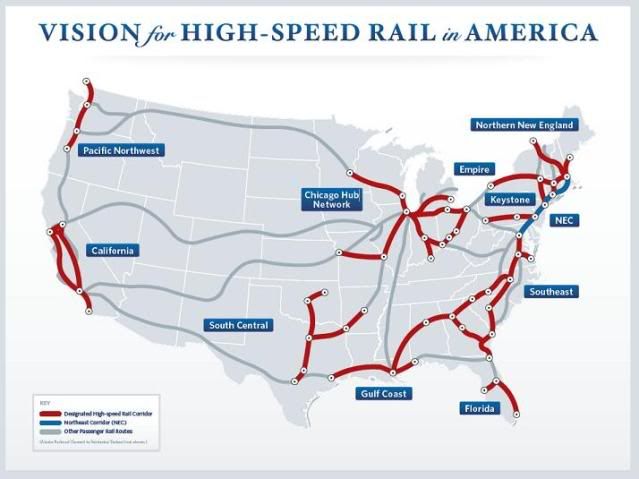
This week the Obama Administration revealed its plans for a system of high speed rail in major America regions. Courtesy of West Michigan Rising, the administration has mapped out several areas across the country it hopes to improve:

"President Obama's vision for high-speed rail mirrors that of President Eisenhower, the father of the Interstate highway system, which revolutionized the way Americans traveled. Now, high-speed rail has the potential to reduce U.S. dependence on foreign oil, lower harmful carbon emissions, foster new economic development and give travelers more choices when it comes to moving around the country."
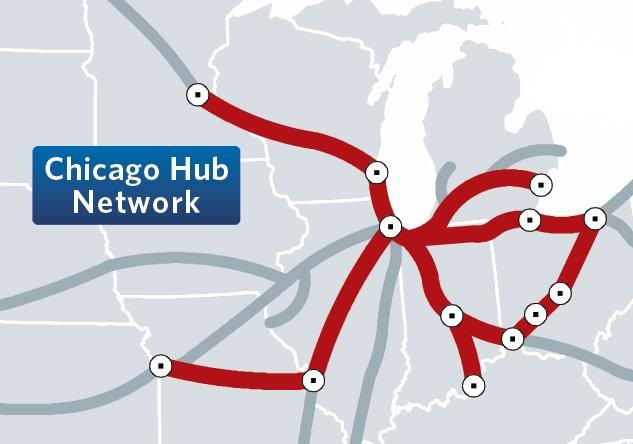
The administration is focusing intently on the Midwest region, where it hopes to connect major cities in the area with the economic hub of Chicago. Which cities would it include as stops on this train? Only time will tell, but I'm sure some of it will be up to us as citizens to promote our cities as ideal stops.

Per the Gazette:

"The money will go not only to high-speed rail development but also to a parallel effort to improve rail service along existing lines ? upgrades that would allow faster train travel.

The White House said funding will move into the rail system through three channels, first to upgrade projects already approved and only in need of funding, thus providing jobs in the short term. The second and third would focus on high-speed rail planning and then a commitment to help in the execution of those plans far into the future when the stimulus funds are no longer available.

The U.S. Federal Railroad Administration says the term high-speed rail applies to trains traveling more than 90 mph (145 kph). The European Union standard is above 125 mph (200 kph)."