Monday, April 20, 2009

Apparently, Debtors Prisons Have Returned


A couple weeks ago, the New York Times reported on a recent phenomenon happening around the United States: Imprisonment for debt. Here's a segment from the story:

"Here is a tale that sounds like it comes right from the pages of “Little Dorrit,” Charles Dickens’s scathing indictment of VictorianEngland’s debtors’ prisons. Unfortunately, it is happening in 21st-century America.

Edwina Nowlin, a poor Michigan resident, was ordered to reimburse a juvenile detention center $104 a month for holding her 16-year-old son. When she explained to the court that she could not afford to pay, Ms. Nowlin was sent to prison. The American Civil Liberties Union of Michigan, which helped get her out last week after she spent 28 days behind bars, says it is seeing more people being sent to jail because they cannot make various court-ordered payments. That is both barbaric and unconstitutional.

In 1970, the Supreme Court ruled that it violates equal protection to keep inmates in prison extra time because they are too poor to pay a fine or court costs. More recently, the court ruled that a state generally cannot revoke a defendant’s probation and imprison him for failing to pay a fine if he is unable to do so."
The article later concludes:
"Prisoners’ rights advocates worry that in these hard times, when government budgets are under pressure, courts and prisons will get even tougher about forcing indigent defendants to pay costs and fees, and will imprison more of them if they cannot come up with the money. The government should be helping people on society’s margins build productive lives. Throwing them in jail for being poor makes that much more difficult."
This is a scary and sobering story, of which its main example inexcusably comes from our state! I always assumed this was one of our most basic rights; I guess some governmental bodies are in disagreement, brought on by very desperate times. I hope we can get past these archaic methods - jailing someone impoverished is a quick way to inflame the problem, not a solution to state budget woes.

It certainly serves as an example, albeit an extreme one, to the complexity of economic struggles in both our state and America as a whole. We need to pull together our resources now and unite, not fight the poorest population for every last dollar.

Friday, April 17, 2009

UPDATE: High-speed Kalamazoo-Niles rail link planned

Today from the Kalamazoo Gazette:

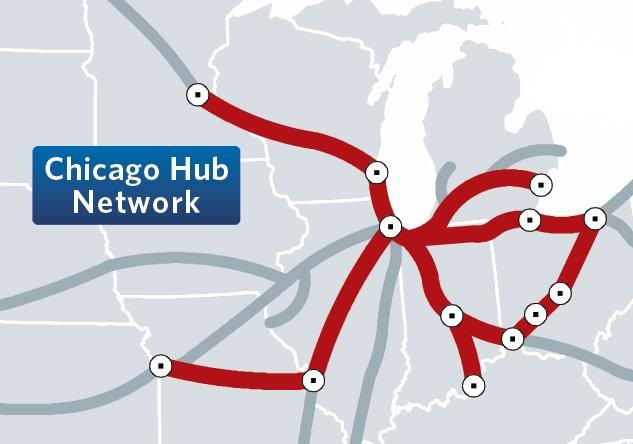
"Boosting speeds to up to 110 mph along a stretch of rail between Kalamazoo and Niles tops the list of plans to improve high-speed rail travel in the Midwest, Michigan Department of Transportation officials said Thursday.

That 43-mile stretch of track could be the first area outside the Northeast where trains are allowed to reach those speeds, MDOT officials said.

The upgrade could be completed as early as this year, MDOT officials said, following President Barack Obama's announcement Thursday that $8 billion in economic-stimulus spending would target high-speed rail corridors nationwide.

"I believe (the Kalamazoo to Niles stretch of track) could be the first place outside the Northeast corridor where we see train speeds over 100 mph," said Tim Hoeffner, administrator of MDOT's intermodal policy division."

Obama Administration's Vision for a High Speed Rail

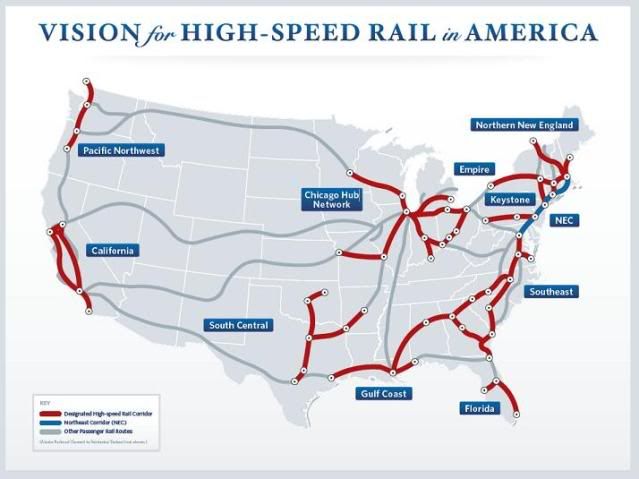
This week the Obama Administration revealed its plans for a system of high speed rail in major America regions. Courtesy of West Michigan Rising, the administration has mapped out several areas across the country it hopes to improve:

"President Obama's vision for high-speed rail mirrors that of President Eisenhower, the father of the Interstate highway system, which revolutionized the way Americans traveled. Now, high-speed rail has the potential to reduce U.S. dependence on foreign oil, lower harmful carbon emissions, foster new economic development and give travelers more choices when it comes to moving around the country."
The administration is focusing intently on the Midwest region, where it hopes to connect major cities in the area with the economic hub of Chicago. Which cities would it include as stops on this train? Only time will tell, but I'm sure some of it will be up to us as citizens to promote our cities as ideal stops.

Per the Gazette:

"The money will go not only to high-speed rail development but also to a parallel effort to improve rail service along existing lines ? upgrades that would allow faster train travel.

The White House said funding will move into the rail system through three channels, first to upgrade projects already approved and only in need of funding, thus providing jobs in the short term. The second and third would focus on high-speed rail planning and then a commitment to help in the execution of those plans far into the future when the stimulus funds are no longer available.

The U.S. Federal Railroad Administration says the term high-speed rail applies to trains traveling more than 90 mph (145 kph). The European Union standard is above 125 mph (200 kph)."

Monday, April 13, 2009

Kalamazoo Promise Still in Need of Comprehensive Vision

The Kalamazoo Promise was a popular topic over the weekend, featured in two Gazette articles. One basically spoke about how it is still holding on in tough times, the other about a new book published about the Promise, which speaks about the difficulties and challenges faced by the Promise.

Many are coming to realize that even though the project has created something truly ground-breaking and inspirational, we still have a long way to go until the true dream of its ideals are actualized.

There is no comprehensive plan to make the Promise a collective community program; it still only exists as an argument for an economic vehicle for college tuition. Until people realize that it will take much more community action to make this program successful, it will continue to raise doubts and suspicions.

The Kalamazoo Promise will not create direct change on its own; it needs to support the children and families in order for them to succeed. As I wrote in a previous post, the Developmental Assets model would be an excellent place to start:

Developmental Assets are common sense, positive experiences and qualities that help influence choices young people make and help them become caring, responsible adults. Studies of more than 2.2 million young people in the United States consistently show that the more assets young people have, the less likely they are to engage in a wide range of high-risk behaviors and the more likely they are to thrive. Assets have power for all young people, regardless of their gender, economic status, family, or race/ethnicity. Furthermore, levels of assets are better predictors of high-risk involvement and thriving than poverty or being from a single-parent family.

We have the opportunity to create a comprehensive vision by plugging in a model that already WORKS and using it to our advantage here in Kalamazoo.

Friday, April 10, 2009

10 Reasons Why You Should Vote Yes for the Public Transportation Mileage in Kalamazoo


1. Our public transportation helps keep people in productive jobs and preparing for productive jobs, with two-thirds of riders using the services for work or school.

2. Our public transportation system is an important factor in the overall viability of our local and regional economy, with high-tech employers saying having a public transportation system is “very important” for business location and re-location.

3. Our public transportation system is a collaborative, inter-connected network that coordinates bus routes
with demand/response service, reducing duplication of services.

4. Our public transportation system provides more than three million rides per year in Kalamazoo County.

5. Our public transportation system is well utilized, providing more than 70 percent more rides than it did a decade ago.

6. Our public transportation system provides well-known, documented environmental and economic benefits to the community, state and nation, including cleaner air, less traffic congestion and decreased reliance on foreign oil

7. Our public transportation system transports elderly and disabled citizens to receive important services throughout Kalamazoo County.

8. Our public transportation system helps individuals who can’t afford private transportation to medical appointments, meetings and life-enriching experiences.

9. Our public transportation system will require only four-tenths of one mill for four years outside the City of Kalamazoo, less than the levy that expired at the end of 2008 for out-county residents.

10. Our public transportation system will require one mill within the City of Kalamazoo, the same as that approved by voters in 1998 and less than that approved by city voters in 2006.

The vote takes place in the city of Kalamazoo on Tuesday May 5th, 2009.

Tuesday, April 7, 2009

Government and Taxes: What role should they play poverty reduction?

One of the long-lasting issues that always surfaces in any situation involving poverty is the role of government in reducing poverty. At times discussing the issue feels more painful than a root canal: but it doesn't have to be.

Though the Poverty Reduction Initiative is not politically aligned and does not lobby government on behalf of these issues, we encourage healthy discussion and discourse on all the topics. In fact, our mission to reduce poverty in the most effective way possible as well as the most beneficial to an entire community whether it is through private or governmental means. In most cases, it becomes a combination of both.

The facts are that inequality in the United States has been growing rapidly in recent years, and though there exists no current data to represent the trend, it is likely that is only growing with the recent economic downturn that has cost so many of the working class their jobs.


So what should be the role of government in addressing poverty? Should the rich take on more tax burden to support the poor? Is it the private industries responsibility to support the communities?

What role should government play?

Monday, April 6, 2009

Developmental Assets: A Potential Template for Community Covenants

At the VISTA training last month in Ypsilanti, I was privileged to see a presentation on the Developmental Asset Model for children conducted by the Search Institute. I was so inspired by the research that when I returned to Kalamazoo I told our director Jeff Brown about what I had learned. It turned out that Jeff was already certified in Developmental Assets and wanted to implement that idea into our community covenant to support the Kalamazoo Promise.

From the Search Institute website:

Developmental Assets are common sense, positive experiences and qualities that help influence choices young people make and help them become caring, responsible adults. Studies of more than 2.2 million young people in the United States consistently show that the more assets young people have, the less likely they are to engage in a wide range of high-risk behaviors and the more likely they are to thrive. Assets have power for all young people, regardless of their gender, economic status, family, or race/ethnicity. Furthermore, levels of assets are better predictors of high-risk involvement and thriving than poverty or being from a single-parent family.
There are forty identified Developmental Assets, which are broken down into external and internal assets. External assets include the categories of support, empowerment, boundaries and expectations, and constructive use of time. Categories of Internal assets include commitment to learning, positive values, school competencies, and positive identity. The individual assets vary upon the age group of the children, but all include these basic categories. You can view each of them on their website:

Early Childhood (ages 3-5)
Middle Childhood (ages 8-12)
Adolescents (ages 12-18)

One of the great pieces of this model is that it stresses programs that center on relationship building and valuing youth, rather than simply implementing new programs. It has the potential to be a great resource when the community is ready to create a covenant to encompass the new vision of Kalamazoo. If we build our model this innovative research, it could have the potential to affect a great number of children and families in Kalamazoo

Thursday, April 2, 2009

Gilmore Museum Aims to Reach Out to Disadvantaged Youths


Disadvantaged teenagers could have the opportunity this summer to work with antique cars, and get paid for their efforts. The PRI is working with the Gilmore Car Museum near Richland to coordinate an educational program that would support low-income teenagers.

Using the Summer Youth Employment program, it has an opportunity to be both a educational experience and a well-paying job. Tim Morris, Gilmore's Director of Education, has experience leading programs at the Kalamazoo Air Zoo. He already has developed an in depth curriculum that meets state level standards. Additionally, the program is intended to excite and prepare these youths to enter car maintenance programs, such as the highly respected one at Kalamazoo Valley Community College.

The only barrier is finding the right source of youth employment to foster the program. With the Gilmore being just over county bounders, they can not access the large stimulus money for teens being poured into the Summer Youth Employment program. However, if they can access the program through Barry County, they have a great opportunity to employ youths and give them an opportunity to succeed in the future.

Wednesday, April 1, 2009

Summer Offers More Jobs for Disadvantaged Youths in Kalamazoo

For disadvantaged youths who would otherwise have little to do this summer, hope is arrived in the form of a $800 thousand stimulus supplement for employment this summer. Hundreds of youths ages 14-24 who are low-income now have the opportunity to have a meaningful and educational experience this summer employed in a non-profit in Kalamazoo.

The stimulus money provides the recruitment, administrative, and training costs associated with hiring. Non-profits who need staff will be asked to take on these workers free of charge - as long as they can find them meaningful work to do. This comes in additional to an estimated $300 thousand dollars which will be raised by city officials - coming to a total of over a million dollars in youth employment funds.

So the great task begins of finding opportunities that will not only keep youths, busy but also show them the value of steady employment and engage them in an opportunity to learn. Sure, you can put a bunch of workers in a park to pick up trash, but the experience may do little to actually change their outlook on life. We need experiences that will be transformational for these youths so that they use them to be more successful in the future.


If you administer a non-profit who is looking to have an educational opportunity or employment opening this summer, consider staffing your agency with the summer youth program. Contact Cincy Sullivan 269-383-2536 x 117 or csullivan@kresa.org

Thursday, March 26, 2009

Kalamazoo Dig: More Community Gardens Make Sense

Community gardens make great sense for Kalamazoo. This is precisely why the PRI was excited to lay the ground work and facilitate the development of several more projects in Kalamazoo.

A community garden combined with recent stimulus money for a summer youth employment program has the potential to great a lasting impression on Kalamazoo urban agriculture. Basically, the stimulus package is guaranteeing the wages for hundreds of youth up to 24 years old; all they need is a place to work.

If we are to expand several more gardens this summer, we will need young people to staff them. These two programs have the potential to work in perfect symmetry. Not only will youth be employed, but it will be far more interesting and involved work that a typical summer job.

There are several other reasons why more gardens make sense in Kalamazoo:

  • They give youths who would have no activities to not only have a productive focus but additionally get paid for their efforts
  • They offer healthy fruits and vegetables and no cost to community resident
  • They are a education tool to teach each other how to create their own garden
  • They build relationships between different ages and backgrounds, and bring each other face-to-face in the community
With plenty of open lots available in Kalamazoo to convert, it should not be difficult process to being. What matters know is if community organizations can embrace and take on gardens as projects of their own interest.